Wednesday, May 4, 2016

Monica Lewinsky- The Price of Shame

This TED Talk was incredible, especially coming from a public figure like Monica Lewinsky. 

Social media has desensitized us because it is so available, frames what we look at and filters we are able to know. As Monica Lewinsky said, “I was seen by many, but actually known by few.” There is no such thing as a privacy anymore because you are seen on a worldwide scale. With cruel stories such as scandals, affairs, and slut shaming a commodity to our public, we begin to see this as the norm rather than a rare incident. The media feeds off of what we as a society pay attention to the most and when millions of people habitually click on cruel and humiliating stories not only does that individual’s reputation become more and more in danger, but the media will consistently report this stories in order to make money.  

Compassion can displace shame in social media by understanding that everyone is going to have an opinion and that you don’t have to fight fire with fire. You can take the initiative to post something positive and not allow your anonymity make you into something that you’re not. Instead of jumping to conclusions or judging others by their comments, listen and try to understand where they are coming from to gain perspective before just speaking your two-sense.

I am prepared to actually pay attention to incivility online. I am an outsider when I comes to reading comments or even posting regularly. I want to understand why people say what they say and not make snap judgments based on their post. I want to make a more positive appearance on other’s posts because every kind word or comment can make a difference for someone, even make their day just a little bit happier. Also, reporting cyber bullying can help someone too. To know that the power of anonymity can destroy or hurt someone’s feelings to a breaking point should not go unnoticed or unattended. Being positive as possible can do wonders for someone. I want to be that person. 

Tuesday, April 19, 2016

Facebook Campaign Analysis

Semester Facebook Analysis 

I’ve taken over the Dixie State Softball page since February and I’ve enjoyed every minute of it! I do think that this was a successful campaign and I look forward to continuing to manage this page until I graduate next spring.

Likes


One of my goals was to boost the amount of likes to our page. The page started with 917 followers from my first post on February 3 and as of today we have reached 1,004. It was tough to promote a page that already had a solid following behind it, but I think through word of mouth and shares of our posts, people from everywhere have gained interest in our program through Facebook. 

Reach

The reach depended on what type of post. Videos and team activities definitely reached more people because of the attraction and tagging of others to view it as well.  The links to our game summaries and conference announcements reached our loyal fan base or what seemed like the same people who pay attention to our updates on a regular basis. Simple posts like on game days or weather delays were the least successful and I’m trying to think of more ways to make them more engaging. It was interesting because depending on what time of day I posted, would determine how big our reach would be. Posting during the afternoon or late at night was more successful than the mornings which was evident in the reach numbers.


Reaction, Comments and Shares

I was blessed to have a lot of positive reactions and comments on my posts. The support that our program receives is incredible and makes me want to do more creative things for this page now and in the future.  I would like to see more shares, but at the same time, our page is to inform. Shares consisted of us players and mostly family members wanting to brag about their niece or granddaughter to the world which is understandable J  

Page Views


I can see why our page views is very sporadic and tough to predict because there is a lot of down time and not every day is there something to post about. I wish I could go back to last year and compare the traffic, but overall I feel like we get a lot of interest from our followers consistently. 


Post Breakdown

Videos and team activity photos definitely have the most views, likes and reach among all posts. I think having a visual is much better than just words. I think that this is an area that I could definitely improve on- more substance. Before, each post was just the link, but what I have realized is that adding a personal touch can get people’s attention. For example, a simple hashtag got people using them on their shares or comments. I think that I did a sub-par job at giving our audience a behind-the-scene look at what being a student-athlete is. I share articles written by the DSU Athletics department and recognize conference accolades, but those are just highlights of our program. Although that is what followers want to read and respond well to, I think videos of games and players on a regular basis is just more entertaining and keeps our audience engaged and gets our name out to the masses as much as possible. There is so much more that goes into being a student-athlete especially off the field, so I plan on capturing the team at community service events or study hall just to give a different perspective.


Audience

I like how our fan base is fairly balanced between genders at 56% women and 43% men. The most popular age group was 18-24 women as well as a huge following from people 35-54 years old. I would like to appeal better to the younger population, but I realize that D I programs would most likely get more attention and interest than a small university in Utah like Dixie State. Based on my Facebook ad that I created, the cities and locations where almost identical. The majority of our audience is in Utah, but interest is scattered along the west coast and growing. Until our program gets more recognition nationally, I think this is the perfect audience that fits our program. 


Summary, Thoughts and Reflection

This page was a success, but as I continue to manage this page, I think there is a lot of work that can be done for better results. I was unable to get an Instagram account set up for this season, so I believe that cross promotion in the future will be a handy tool to help increase some traffic for our program on all social media accounts. We did share a couple of posts from Twitter that got decent acknowledgement, so I want to make cross promoting a priority and more evident in the future. I also was unable to do player profiles on our team this season which I am disappointed about, but I am assigned to do the end of the year wrap-up video which will be bittersweet. Also, I think that two of the three personas were met. I believe that the younger audience will come in time as our program gets more and more national recognition, but family members and community supporters definitely play a big part in the popularity of our page and we are grateful for their constant support through our season. 


Tuesday, April 5, 2016

DSU Softball Facebook Ad

My Facebook ad that I created to promote the Dixie State Softball page would potential reach 3.4 million people. I know that my audience was going to be broad because I want to reach people not only in-state, but throughout the west coast due to potential athletes interested in being recruited as well as parents of current teammates. I had no desire to alter the image due to the new branding of the university. Changes in the future may occur just for a fresh look :)


Thursday, March 24, 2016

My Automatic Attitudinal Response


I can honestly say that I have struggled to write every Well Informed and OTM post this semester. When talking about racism, democracy, or religion, I kind of just shrug these issues off because I was stubborn to express my opinions or had a tough time identifying what my standpoint was to begin with. I’m pretty sure I am the definition of a naïve citizen in this world but, if this class has taught me anything it’s that I need to be more engaged with what is going in society, be informed about all the factual aspects pertaining to these topics, and know myself well enough to be able to know where I stand.

Looking back on my posts, I feel like I’m just generalizing the situation and implying psychological, social or cultural context through research and vaguely through my own perspective. This sounds terrible, but I feel numb to all of these topics when in reality I should be educating myself especially when I’m uncertain about something. I observe Candy, who sits next to me, during class and she is always prepared to look up what we are talking about or anything she is unsure of. I feel I need to take the initiative to be better informed in order to break these cognitive barriers about controversial issues. I need to gain knowledge in all areas of society and if I’m not familiar I need to know reliable resources that will give me the facts.

I believe this fault of mine is a result of my reliance on social media as my main news source. This quote by Professor Young opened my eyes to how easily we can be persuaded to think a certain way without even knowing it, “When our own opinions and positions are bolstered by what can appear to be a majority of others, we can easily become entrenched in a skewed perspective of reality.” I clearly need to expand my resources. I am a victim of framing my perspective on society through social media when I need to be able to see past the biases that they threw at me. I have to research both sides and be neutral in order to overcome hidden assumptions, ethnocentrism, and primary certitudes.


I’m not by any mean saying that I’m not bias or prejudice in certain situations, but I think I’m naïve to it because I keep everything to myself so I’m not sure how people will react. I don’t have much feedback to fall back on, but I try my best to fight just expressing my own opinions no matter what. I respect people’s points of views, backgrounds, and cultures and allow them to be free about it too. I will say I joke a lot about stereotypes in the kindest way possible without offending anyone, but I think I do a good job of playing devil’s advocate in a discussion. The barrier that I most need to work on is be more educated and have valid reasoning behind my views while still being open to others.

Tuesday, March 22, 2016

OTM #3- Who Are Trump Supporters?

Donald Trump’s presidential campaign to me is unorthodox and full of questionable tactics, but it seems to be working. What started as a potential political satire has turned Trump into the front runner of the Republican Party. How is this happening and what is the makeup of his fan base? Racists, the working class, impatient citizens in need for change?

The Atlantic’s national correspondent James Fallows believes this is a complex contradictory movement. We are constantly going back and forth of who his followers actually are without coming to any permanent conclusions. Fallows illustrated the feedback of a variety of public opinions that included vile remarks about Trump or that the media doesn’t know what goes on in real America, but then he get those who understand and try to sympathize with Trump.

Fallow’s describes the “normal” person as those who stick to their political ideology and do not seem like creatures of the extreme, who like Trump’s rashness and are not that afraid of what he would do in office.

One of Fallow’ theory of Trump’s success is that main media narrative of this movement represents racial tension, economic exclusion, and inpatients with politics along with Trump himself. People don’t care about his unique performance or background, but have more of the psychological disposition with trump than probably anyone else.

Fallow’s solution for the media coverage is to ,”try to recognize number one that this is a complicated fast moving situation that we aren’t going to understand in real time. Economic realities, what are racial dimensions, do as much explanatory work on hydraulic of America 2016 and less rally coverage but more talking about the country that is making the decision and the person about whom they are choosing.” The media must focus on the task at hand which the presidential primaries rather than just the next Trump fiasco in order to give people an honest perspective on who is fit for president. 

This becomes an interesting cultural matter in politics with the identity of the Republican Party. There is an alliance of modern Republican Party between economic royalists and cultural conservatives that are having racial or religious resentment. This can cause a shift in the face of the party with Trump and those in the future.

I agree with Fallow’s when he said, “Trump expresses the views of those who feel the object of that scorn then that would be true.” Trump represents those who feel victim of what is going on in the world. This political dilemma is presumably tainted by money, biased toward privilege or welded to the status quo is unknown for now, but has the possibility of become a reality sooner rather than later. 

Tuesday, March 1, 2016

Democracy 2.0

The 2016 primaries have literally left me speechless and it’s easy to say that Donald Trump’s presidential campaign is one for the books.  If we can barely come to terms with Trump potentially becoming president, could you imagine the rumors about Kanye West’s run in 2020?

I’ve had a chance to watch the debates and rallies leading up to the biggest day of the primaries, Super Tuesday. 13 states will hold their elections tomorrow and Trump seems to be in control. How? The media is eating out of the palm of Trump’s hands with all the publicity his campaign has been getting. An analyst referred to Trump as a trailblazer for politics even though he has no political background. I feel like Trump’s absurd tactic and comments are meant to distract us from the real issues. If you listened to his speeches Trump just bashes other candidates, countries or people to please the crowd and then briefly goes over important issues like foreign policy or health care.

Many of my friends have expressed their opinion on social media about Trump and how this ridiculous joke has the potential to become a reality within months. 


I come across a post about Trump on my Facebook and Twitter feeds daily and with these videos or memes being constantly viewed and shared only makes Trump’s stock go up. The fact that we as a society devote some much effort to criticize or critique Trump over all the other candidates is the attention Trump has lived for his whole life, especially now on the biggest stage of them all. The funny thing is Trump degraded the media, in particular the New York Times, in his rally in Texas Friday morning. Trump wants to change laws so that the media can’t say negative things about him… ironic since they are a major factor in his success.  Also, on Friday before the announcement of the Chris Christie endorsement, Marco Rubio mocked Trump’s tweets and tried to “fight fire with fire”. I just thought to myself, “Is this what our country has come too? Who can talk sh*t the best?” I’ve gained the mindset of voting for the candidate that is going to the least amount of damage to our country for the next four years, but yet I am still dumbfounded.

Any individual who thinks they are qualified to be the most powerful person in the world should be required to have political background of some sort. I think that every candidates should hold office of an applicable political position for at least one full term before even be eligible to run for president. To me experience is essential to everything in life. You don’t get hire to become a CEO of a company with no job experience, so why are we letting a power thirsty businessman or a mediocre rapper even be in the conversation of politics let alone being the leader of the free world? There need to be stricter requirements for this office because it is so important to our nation’s future. I’ve come to idea that we have lost sight of good leaders who want the best for the American people and instead accept those politicians who say what we want to hear to get elected and then pursue their own self-interests. Was Christie’s endorsement in spite of Hilary Clinton or just to get a seat in the White House? Politics are complex and apart of the foundation of this country was built on, therefore we can’t just let anyone be president. We should have higher standards for a position of such powerful representation of the citizen of the United States.

Monday, February 22, 2016

Religion 3.0


Religion is can be very influential depending on your background, surroundings and lifestyle. I did not grow up going to church or practice a specific religion, but occasionally I do go to a service for my friends. I respect people who are religious and believe in a God, but I would consider myself an agnostic, or a person who believes that nothing is known or can be known of the existence or nature of God or of anything beyond material phenomena; a person who claims neither faith nor disbelief in God (Google). 

Religion never played a significant role in my upbringing, but as I’ve gotten older I see the effect it can have depending on where you live. I was born and raised in Southern California where religion was quite diverse. I would say half of my peers growing up were religious and the others were not. California’s breakdown of religion goes as followed: “45.00% of the people in California, California are religious, meaning they affiliate with a religion. 27.89% are Catholic; 2.07% are LDS; 5.28% are another Christian faith; 0.58% in California, California are Jewish; 1.18% are an eastern faith; 0.73% affiliates with Islam” (BestPlace). With such an assorted group of religions around, there was no pressure to be affiliated with any of them.

I spent my first two years of college in New York. This is the melting pot of the world, so of course I witnessed a variety of religious representation almost every time I was in NYC. New York’s religion breakdown goes as followed: “51.21% of the people in New York, New York are religious, meaning they affiliate with a religion. 33.17% are Catholic; 0.41% are LDS; 3.10% are another Christian faith; 4.05% in New York, New York are Jewish; 0.62% are an eastern faith; 2.03% affiliates with Islam” (BestPlace). I’ve been fortunate to live in arguably the most diverse states in the nation where the acceptance of varied religions is reasonable.

I must admit that transferring to Dixie has been an adjustment due to the religious dominance of LDS. Utah’s religion breakdown goes as followed: “79.11% of the people in Utah, Utah are religious, meaning they affiliate with a religion. 6.01% are Catholic; 69.14% are LDS; 0.83% are another Christian faith; 0.06% in Utah, Utah are Jewish; 0.39% are an eastern faith; 0.18% affiliates with Islam” (BestPlace). I grew up with some Mormon friends so I wasn’t completely oblivious to the practice, but the fact that one religion is dominate is new to me based on my previous and current living experience. 

Today, I see many of my friends posting on social media to express themselves religiously. In a World Religion News article “5 Ways Social Media Connects Religion to Young Generations” it talks about how learning or practicing a religion has become more accessible through apps and how apps like Instagram or Twitter are platforms for more expression. There probably isn’t a day I could recall where I didn’t see at least one post about a specific bible scripture, a religion or even God and that’s perfectly okay with me.

I have complete respect and appreciation for anyone who devotes their time, effort and energy to practicing a religion. My one rule is to not influence me to join or judge me because I have no religious affiliation. I will respect your way of life as long as you respect mine.


Wednesday, February 17, 2016

OTM#2- Reporting Zika, Without Panic

Zika is a mosquito borne illness by Aedes aegypti mosquito that is sweeping through the Western Hemisphere and has been reported in southern areas of the United States. Symptoms have been observed to be associated with microcephaly and the potential effects lead the World Health Organization to declare Zika as a global health emergency.

Reporter Johnathan Katz was in Haiti last month, showed symptoms of Zika, and shared his experiences in New York Times Magazine. Katz believes that Zika is not medical emergency even though he felt rundown and experienced rashes on his face and chest. He has experienced mosquito borne diseases before like Chikungunya and described Zika as mild in comparison.

The question is should we as a nation be seriously concerned? Personally, this is the first that I’ve heard of this disease. Obviously if you live in warmer areas that are susceptible to mosquitos I think you should be aware and educate yourself of your surroundings. Katz stated, “As the planet gets warmer the range of this particular mosquito and other mosquitos will expand and more areas will be affect by mosquito borne diseases than were in the past.” Similar to the Ebola outbreak, I think it good to be knowledgeable about this, but I don’t think we as a nation should be freaking out. Katz illustrated that these diseases start in international places of poverty with little to no power and they have been reported in U.S areas such as Boston that have a slim chance of transmission due to the weather and mosquito history.

Katz commented, “People will only start pay attention to something when they freak out about it. This leads to another problem. Not everything you prepare for is going to happen to you, but you always needs to prepare. The way that human nature seems to work is that If you tell people to prepared something and it doesn’t happen, there is a little “Boy that cried wolf” syndrome.”
I believe that the U.S should not panic. I just think of Ebola and how hyped up it became for a week and then we never heard of it again. Although this is new to the Western Hemisphere, It good to inform the public of what the knowns and the unknowns, but until Zika has shown serious signs of outbreak we should not worry so much about ourselves, but for those suffering overseas.

In the video they played sound bites of new stations across the nation and the anchors did report with a sense of urgency in their voice. Katz brought up a good question when addressing the media, “What are you communicating when you report the news like that. What are you actually telling people?” When I heard those sound bites, I was concerned I had never heard about Zika and that it was reported on U.S soil. Listening to Katz who has experienced Zika and these diseases put me more at ease because he has credibility. I think the media is moving too fast on the matter whereas Katz is casual and not phase by the situation. “Scaring people just for its own sake, doesn’t really accomplish anything. The more dramatic and the direr you make it sound the worst the boy who cried wolf syndrome is going to get afterwards.”

I think when it comes to these outbreaks the media can’t rush to report as if it is an emergency, but instead just inform. I know that is counter intuitive to their jobs, but we can’t get to nervous about this. The news should report all sides of the story instead of just the negative because that when people start to get concerned. Instead of making the public scared we should be working overseas to help stop the formation of these diseases.

“If diseases can make its way overseas to America, we needs to work together internationally to try to address the systemic roots of poverty so we can prevent those diseases to crop up anywhere.” 

I know this is easier said than done, but like Katz, we shouldn't panic. 

Tuesday, February 16, 2016

Privacy 2.0


Have you ever googled yourself? Are you surprised what you find? Are your social media accounts like Twitter, Facebook or Instagram just a click away? Once we create a profile on a social media outlet and start sharing pictures, opinions or personal information, are our lives an open book?

Pew Research Center conducted a survey of teens to examine their privacy management on social media sites. “When asked whether they thought Facebook gives anyone else access to the information they share, one middle schooler wrote: ‘Anyone who isn’t friends with me cannot see anything about my profile except my name and gender.  I don’t believe that [Facebook] would do anything with my info.’ Other high schoolers shared similar sentiments, believing that Facebook would not or should not share their information” (Pew).  Even though this survey is a little dated, with this mentality more people are willing to post more intimate details about themselves such as where they live or their phones numbers.


Social media is built on the idea to share what we are doing with pictures, 140 characters or a status update. “All of this sharing may help create communities, but it also destroys privacy…Social media is not simply a collection of online places that allow private information to escape, but social media sites are organized to draw as much participation and information out of us as possible” (American Bar). Social media doesn’t give away our information, but in fact we do it to ourselves. We insist on posting to these apps to inform people about what we are doing constantly or gain followers, likes and retweets to feel popular and less insecure. We have the ability to control how much privacy we want.

 “On one level, many of us broadcast our own photos and videos, reveal our relationship statuses, religions and political preferences, and post our job histories. These kinds of personal details are widely shared – and released under our control” (Guardian).  We are willing to put the information online thinking we control the audience and everything is safe, but it’s the little things that can put us in danger. “However, there's another level of sharing when we become active participants, engaging with social media sites that encourage us to "check in" at various hotspots or connect with other users via our location. We give the power to watch and manage our information to someone else, and prove we're OK with that” (Guardian). When we are constantly allowing apps to use our direct location, this makes us vulnerable to “creepers” or easy targets into our lives without even realizing it.

John W. Whitehead of the Rutherford Institute pointed out that technology has become our worst enemy, “The very technology we hailed as revolutionary and liberating has become our prison, jailer, probation officer, Big Brother and Father Knows Best all rolled into one…Consider that on any given day, the average American going about his daily business will be monitored, surveilled, spied on and tracked in more than 20 different ways, by both government and corporate eyes and ears. A byproduct of this new age in which we live, whether you’re walking through a store, driving your car, checking email, or talking to friends and family on the phone, you can be sure that some government agency, whether the NSA or some other entity, is listening in and tracking your behavior” (Rutherford). Although this is not social media, this opened my eyes to see that we are always under a microscope at some given time. This is pretty insane, but we allow this and won’t do anything about it. 

I personally have all my account public because I don’t put anything online that I wouldn’t be afraid to show my parents. My dad was a little paranoid and concerned that when he googled me that all my accounts came up, but he trust me to be responsible with what I share. I am an advocate of public profiles because when it comes to jobs and how companies got through their application process, I’ve seen apps that request your social media account names. If you’re hesitant to give up your accounts to be checked then you should reconsider what you post. Corey Carvalho, associate director of the University of Massachusetts Student Legal Services Office, said the first thing he asks students preparing for jobs is, “Will you pass your Google interview?” (Recorder). As social media and technology become more important in the way we communicate with one another, it’s vital that you are honest with yourself and triple think if that is what you want your friends or even future employers to see and think of you. I am an advocate that social media is a positive tool for networking and not to keep information behind closed doors because if someone really wanted to know about you, they could find a way. I don’t believe privacy exist anymore.

https://www.rutherford.org/publications_resources/john_whiteheads_commentary/creepy_calculating_and_controlling_all_the_ways_big_brother_is_watchin

Tuesday, February 9, 2016

Learning 2.0


On twitter if you follow parody accounts like Student Problems or College Humor, you see a lot of entertaining tweets that pokes fun at the struggles of being a high school or college student and I remember one tweet said, “School isn’t about learning anymore, it’s about passing. Smh.” I think this statement is true and I can say I am a victim of this trend to a certain extent.

Being a communications major, I’ve tried to avoid math at all cost. The only reason why I passed math was because I memorized the steps to solve the questions on the test and then forget the process right after. If you were to show me a geometry question now I wouldn’t know how to solve it and have to re-read the lesson. I think this common for students and drift to have “short-term memory”, especially in classes or subjects that don’t pique their interests. In Ben Orlin’s article, “When Memorization Gets in the Way of Learning” he said, “Memorization is a frontage road: It runs parallel to the best parts of learning, never intersecting. It's a detour around all the action, a way of knowing without learning, of answering without understanding.” I memorized math to pass, not to learn and to truly understand. People obtain information that is most intriguing to them. As Sugata Mitra said in his TED Talk, “Children will learn to do what they want to learn to do.”  I’m not saying memorization to not be important because it is a valuable skill in certain areas for example rhetoric, but it doesn’t help learn and understand material in the long term. Orlin said,” Memorization's defenders are right: It's a mistake to downplay factual knowledge, as if students could learn to reason critically without any information to reason about. But memorization's opponents are right, too: Memorized knowledge isn't half as useful as knowledge that's actually understood.”

The Huffington Post wrote an article, “45% of Students Don’t Learn Much in College”, that featured UCLA student Yahya Fahimuddin, who said, "Honestly, you can get by with Wikipedia and pass just about anything." Even at one of the most respected universities, mastering material is not as important as meeting course goals and getting through material on time.

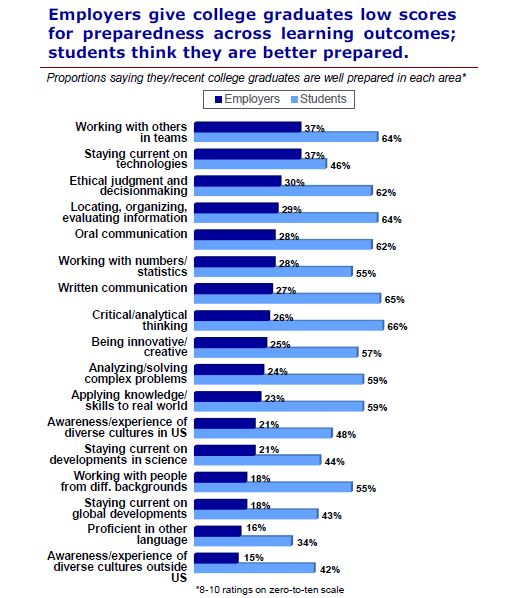
My question is- by just doing enough to pass, are you really prepared for your future? A study done by the Association of American Colleges and Universities (AACU) did a study that surveyed 400 organizations that have 25 percent or more of their new hires holding either an associate degree from a two-year college or a bachelor’s degree from a four-year college. As shown on the bar chart below from AACU, students consistently rank themselves as prepared in areas where employers do not agree. 
I think this opens my eyes that I need to be more conscious of learning and retaining material instead of just dong enough to pass and not being fully prepared for my career. 

http://www.huffingtonpost.com/2011/01/18/45-of-students-dont-learn_n_810224.html  
http://www.theatlantic.com/education/archive/2013/09/when-memorization-gets-in-the-way-of-learning/279425/
https://www.insidehighered.com/news/2015/01/20/study-finds-big-gaps-between-student-and-employer-perceptions 

Tuesday, February 2, 2016

OTM#1- The Many Faucets of Radicalization


This week’s On the Media brought some light to a constant national concern- terrorism. What is our government doing to help fight terrorism, especially online? Recently, government officials traveled to Silicon Valley, the home of tech companies such as Apple and Facebook, to begin the making of an algorithm to detect signs of radicalization similar to a person’s credit score.

Georgia State Professor John Horgan, who studies terrorist behavior, is skeptical about the success of this algorithm.

“Radicalization is such a complex process… if there is one conclusion that has emerged from about 40 years of research is a story of diversity. We have a lot of different people becoming involved in terrorism in lots of different kinds of ways.”

I agree with Horgan and the fact that radicalism is hard to reduce and define in order to be properly measured and detected especially on the internet (it’s not small to say the least). What I think is radical will be different than your definition. What is appropriate behavior to me might be offensive to you. Even Karen Greenberg of Fordham University School of Law said in the segment “Detecting Terrorism Online Raises Legal Questions” that there is a wide range of legal opinion on what can be deemed as terrorism. I think the legal system will have a variety of interpretations of probable cause for criminal activity and in dictating the distribution of warrants.


I appreciate national security and tech companies taking action to protect our nation and making us feel safe as possible. In my mind, I’m paranoid and I always think that terrorists are always one step ahead. Maybe I give terrorists the benefit of the doubt but, when they find out we have an algorithm, they’ll stop searching online or take more caution in order to beat the system. Then what is privacy anymore? Everyone is under a microscope. We’ve probably already giving up this right to the government and I don’t mind as I’m sure many of us in the class probably think its minor price to pay, but I can see push back from others.

Also Horgan said, “Tracking people who have an interest in exploring radical sentiment but that will in no reliable way allowed you predict who is likely to become involved in terrorism. There is nothing wrong with being radical. There is nothing wrong with holding radical views and in some cases expressing radical views.” Many people have radical views, but don’t have any interest in being involved in terrorism. How do you differentiate who is a supporter and who is active? In his research, Horgan stated that some ISIS support begins and ends online with no intentions of actually engaging in terrorist activity. Would we be distracted and waste our time finding just supporters rather than the real active members? Safety first indeed.

I see pros and cons. With this algorithm, it’s a step in the right direction for our safety and hopefully a victory for America on our soil. I think it will detect a few and save grief for many communities. As far as major radical or terrorist personnel, I think its going to be tough to narrow down and detect. 


Monday, January 25, 2016

Racism 2.0


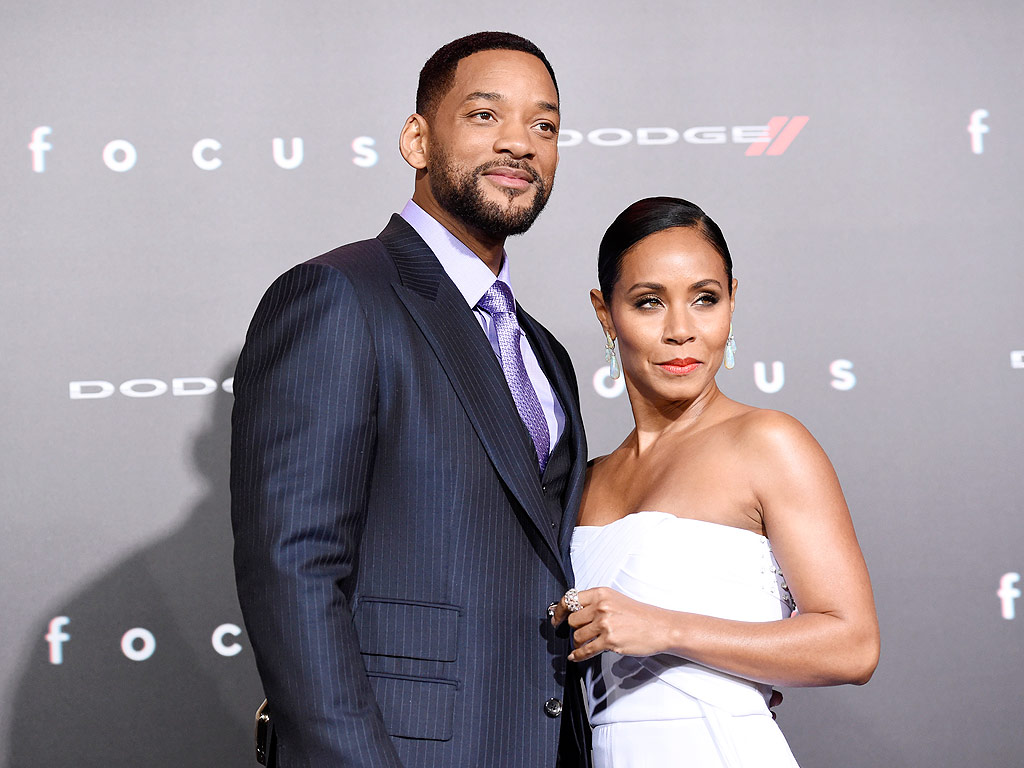
A hot topic right now in the media is the Oscar Boycott led by Actor Will Smith and his wife, Jada, who have decided not to attend the award ceremony, February 28, due to the lack of African Americans on the nominations list the past two years. This stance has received support and criticism from others among the film community.

Will Smith said in an exclusive interview on Good Morning America, “Diversity is the American superpower. That is why we are great. So many people different places adding their ideas, their inspiration and their influences to this beautiful American gumbo. At its best, Hollywood represents and creates the imagery for that beauty. But for my part, I think I have to protect and fight for the ideals that make our country and make Hollywood community great. When I look at the series of nominations, the academy is not reflect its beauty.”

I’ve looked back on the nominations lists since 2006 and I counted 9 nominations for African Americans in both the actor and actress in a leading role category. This is not the first time this has occurred where no African Americans have been nominated in back to back years (2008 and 2009).

I see Will Smith’s call to action of racism in the film industry, but I don’t believe this is racist. 

Actor Michael Caine said, “You can’t just vote for an actor cause he’s black. He’s not very good, but he’s black then I’ll vote for him. No, you’ve got to give a good performance… Be patient. It will come. It took me years to get an Oscar.” (https://www.youtube.com/watch?v=HIdhnd51yM8)
Let’s not even talk about Leonardo DiCaprio’s Oscar drought….


I agree with Caine and that actors and actresses must earn their nomination, it's not given to them because of their race. Is there a rule that states at least one African American has to be nominated each year? All an actor or actress can do is give the best performance they can and the rest is in the hands of the academy; Race should not be a factor.

I think the real question to ask is are there enough Oscar-worthy roles for African Americans and even minorities each year that reflect the standards of the Academy Awards?” George Clooney commented, “Honestly, there should be more opportunity than that…By the way, we’re talking about African Americans. For Hispanics, it’s even worse. We need to get better at this. We used to be better at it.” (http://variety.com/2016/film/news/george-clooney-white-oscars-1201682504/

The Academy president Cheryl Boone Isaacs announced that the academy is pledging to double the number of female and minority members by 2020, and will immediately diversify its leadership by adding three new seats to its board of governors. (http://nypost.com/2016/01/22/oscars-adopts-diversity-reforms-after-race-controversy/) I think this is a step in the right direction to create a more diverse perspective in the academy, but the belief that it will change which races are nominated, is questionable.

My Opinion

We’ve come a long way since slavery. I agree with Smith when he said diversity is America’s superpower. Unfortunately, racism is here to stay, especially if people keep using their race as leverage or a tool to segregate America. As a citizen, all I ask for is equality or a fair chance as an individual, not because I'm Asian. You can't demand more than the average person or expect to be treated any greater because of your race, religion, or sexual orientation. 

I think stereotypes play a role in our perception of certain races that believe they don’t even have equal rights and I acknowledge that there are biases. (Know that stereotypes are generalization affiliated with certain groups of people whereas racism is the belief that a race is inferior to another. www.quora.com)  

 I try to condition myself to see people as equals. My personal stance on racism is similar to religion and gay marriage. I will respect your beliefs as a Catholic, your decision to marry someone of the same gender and the color of your skin, but by having the same rights, you can't expect the special treatment.


Monday, January 18, 2016

Dixie State Softball Facebook Page

This semester, I will take over the Facebook page for Dixie State Softball. I’m really looking forward to do this! By posting frequently, I hope to keep our followers of all ages informed of what the team is doing, when and where we will be playing, and the results of our games, but ultimately I want people to get a glimpse of what it is like to be collegiate student-athlete. I think it will be great way to promote Dixie State as well as be a reference tool for young athletes interested in playing softball in college. I want to provide a behind-the-scene look with videos, pictures, and testimonials to let people know what Dixie State softball is all about!

\


Mission Statement: 

This DSU Softball page is where family, friends, and fans get the latest updates about our program. We are devoted to keep our followers updated with the team's scores and accomplishments as well as an inside look at the fun and excitement happening on and off the field. This a great way to stay connect with the Red Storm!

Three market personas include:

Riley Gonzalez, 16. Riley is interested in playing college softball and is trying to earn her education through an athletic scholarship. Her coaches have encourages their players to look into colleges that share their athletic and educational interests such as major, location, or graduation rate. Riley can come across the DSU softball page and get educated on the program and venture over to the Dixie homepage where she can look more into the school.

Byron Yung, 56. Simply put, this is my dad. My dad has and still is very invested into my softball career. Although he can just go to the athletics website for final scores and stats, with the Facebook page, he can "keep a close eye on" what the team is doing in preparation for games such as traveling days, practices, or even community service projects we participant in. The athletics page only scratches the surface of our season where as our Facebook page give him a look at what we do on and off the field. 

Jim Bo, 70. Jim is retired and resides in St. George with his wife, who are enormous supporters of Dixie athletic teams. Jim isn't as technology savvy, but is quite active on Facebook. By liking the softball page, Jim will get the latest updates on when our games are so that he and his wife can attend, and the results of the games for when we are away. The Facebook page is handy for Jim because he doesn't have to keep switching from website to website, it's just click away on the same app. Also, Jim can become a booster to help support our team's endeavors.

In addition to Facebook, I hope (it's not definite yet) that I can also do the softball Instagram account. Sometimes, visuals are more appealing to followers than just words. In addition, I want to make player profiles, time lapses and have testimonials on the Facebook page which I can promote on Instagram because I believe Instagram only allows for 15 seconds of video per post. I want to get the Dixie State name out there, so friend and page requests are crucial. I am on a mission to get people to click the "like" button or double tap on a link just once, because I think that's all it takes to get Dixie State Softball onto your News Feed and then it's my job to keep you interested.


Wednesday, January 13, 2016

#SOTU

I followed the SOTU hashtag on Instagram and it was interesting to follow specific items Obama touched on that gain positive or negative feedback. Some pictures were Obama quotes about working together to create necessary change, his reference to “We the People”, curing cancer and available education. Surprisingly, many pictures on my feed were about audience members, in particular Michelle Obama, Joe Biden, Kim Davis, and Speaker Ryan. Lots of memes about certain facial expressions they made or what they were wearing. Some people screenshot Donald Trump’s tweet about Obama’s speech. Overall, I would say people would post to praise than hate on Obama’s speech and others were posting just to make fun of the situation in general like my friends who posted on snapchat about audience members (below). 


I’m not a follower of politics, but I’ve become more interested since I’ve been in college. Therefore, the content of Obama’s speech didn’t have any influence or sway me in any political way, but I do have a lot of respect for him. I appreciate his optimistic perspective of our nation’s future despite all the negativity going on in the world. Although it is his last year in office, Obama is still driven to create change and plans to improve America despite this “stalemate” in our government and election season.