
Being a communications major, I’ve tried to avoid math at all cost. The only reason why I passed math was because I memorized the steps to solve the questions on the test and then forget the process right after. If you were to show me a geometry question now I wouldn’t know how to solve it and have to re-read the lesson. I think this common for students and drift to have “short-term memory”, especially in classes or subjects that don’t pique their interests. In Ben Orlin’s article, “When Memorization Gets in the Way of Learning” he said, “Memorization is a frontage road: It runs parallel to the best parts of learning, never intersecting. It's a detour around all the action, a way of knowing without learning, of answering without understanding.” I memorized math to pass, not to learn and to truly understand. People obtain information that is most intriguing to them. As Sugata Mitra said in his TED Talk, “Children will learn to do what they want to learn to do.” I’m not saying memorization to not be important because it is a valuable skill in certain areas for example rhetoric, but it doesn’t help learn and understand material in the long term. Orlin said,” Memorization's defenders are right: It's a mistake to downplay factual knowledge, as if students could learn to reason critically without any information to reason about. But memorization's opponents are right, too: Memorized knowledge isn't half as useful as knowledge that's actually understood.”
The Huffington Post wrote an article, “45% of Students Don’t Learn Much in College”, that featured UCLA student Yahya Fahimuddin, who said, "Honestly, you can get by with Wikipedia and pass just about anything." Even at one of the most respected universities, mastering material is not as important as meeting course goals and getting through material on time.
My question is- by just doing enough to pass, are you really prepared for your future? A study done by the Association of American Colleges and Universities (AACU) did a study that surveyed 400 organizations that have 25 percent or more of their new hires holding either an associate degree from a two-year college or a bachelor’s degree from a four-year college. As shown on the bar chart below from AACU, students consistently rank themselves as prepared in areas where employers do not agree.
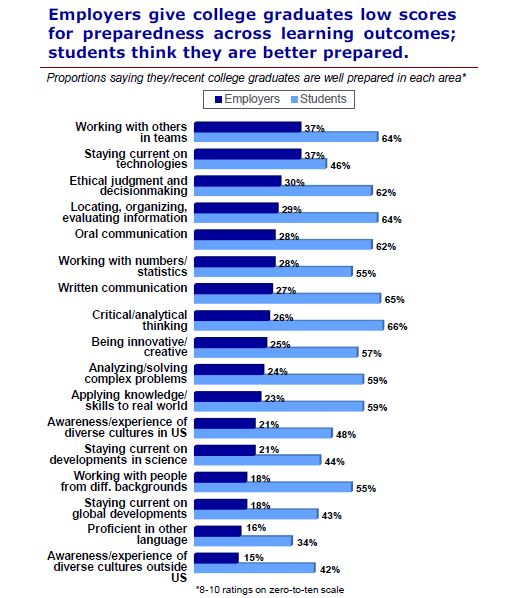
I think this opens my eyes that I need to be more conscious of learning and retaining material instead of just dong enough to pass and not being fully prepared for my career.
http://www.huffingtonpost.com/2011/01/18/45-of-students-dont-learn_n_810224.html
http://www.theatlantic.com/education/archive/2013/09/when-memorization-gets-in-the-way-of-learning/279425/
https://www.insidehighered.com/news/2015/01/20/study-finds-big-gaps-between-student-and-employer-perceptions

Your post reminds about a comment that pretty much sum ups this trend... "C's earn degrees." There is this saying in basketball, as I am sure you have probably heard it in softball as well, and that is "going through the motion." I feel like that is what the majority of people are doing in college, just going through the motions, taking the steps they need to take. Just like athletes do in practice sometimes during drills, they just "go through the motions" and do not really compete or apply themselves to make themselves better. I feel this is actually a life trend for a lot of people.
ReplyDeleteOne last comment, I had a professor tell our class at the end of last semester that the real learning happens with what you do with what you learned after the class.
Hello, Shelby! When you mentioned avoiding math, I was raising my hand, like, "Hey, that was me, too!" Ha ha, it was the last class I needed for my Associate's. Looking back, I'm glad I took it, though. I finally understand some of the concepts I was taught in high school. Does this means I like math? Absolutely not, but I know I can do it if I ever need to. Anyways, that's a whole other conversation.
ReplyDeleteYou brought up an interesting point about how college students feel more prepared for the real world than they might actually be. I can't help wondering if it's a generation thing or if we really aren't learning the proper skills to survive in the workplace. Perhaps employers are expecting more from Millennials? Sounds like an interesting thing to check out. Thanks for the informative post!
Do you feel like you've learned enough in college to carry into your career? Or have you just been completing assignments trying to graduate as soon as possible?
ReplyDelete